
Fine Dust From Fireplaces and Wood-Burning Stoves – An Underestimated Danger
Cosy Warmth With Invisible Pollution
A crackling open fire creates atmosphere, provides extra warmth and gives a feeling of independence. Many homeowners therefore use their fireplace or wood-burning stove regularly – especially during the heating season. What is often overlooked is that every combustion process releases fine dust, which enters the ambient air via the chimney – right where you and your neighbours live.
Fine Dust From Wood-Burning Stoves and Wood-Burning Ovens – Small Particles, Big Impact
Fine dust from wood-burning stoves and wood-burning ovens is not visible to the naked eye. The particles are so small that they float in the air and can enter the respiratory tract with every breath. Older or technically outdated wood-burning stoves without stove fine dust filters in particular can emit significantly more fine dust than many users are aware of – in some cases more than a modern diesel car under real driving conditions.
Why the Problem Is Often Underestimated
Wood is considered by many to be a ‘natural’ fuel, so the impact of fine dust is often underestimated. In addition:
- The particles are not visible to the naked eye, so the impact is hardly noticeable in everyday life.
- The emissions are generated locally in residential areas, not just in industrial areas.
- The sum of many individual wood-burning fires can noticeably worsen the air quality in a neighbourhood – especially on cold winter days.
According to evaluations by the Federal Environment Agency, domestic wood burning in winter contributes significantly to particulate matter pollution in many regions. This is exactly where modern particulate matter solutions for wood-burning stoves come in: they help to significantly reduce emissions without you having to forego the pleasant warmth of your wood-burning stove.
What Is Particulate Matter (PM10/PM2.5) – And Why Is It So Critical?
Particulate Matter Explained Briefly: PM10 and PM2.5
Particulate matter refers to tiny particles that float in the air. Two size classes are particularly relevant:
- PM10: particles with a diameter of less than 10 micrometres
- PM2.5: particularly fine particles measuring less than 2.5 micrometres
By way of comparison, a human hair is around 50–70 micrometres thick. Fine dust particles are therefore many times smaller – and that is precisely what makes them so problematic. The smaller the particles, the easier it is for them to penetrate deep into the respiratory tract.
Health Consequences of Particulate Matter
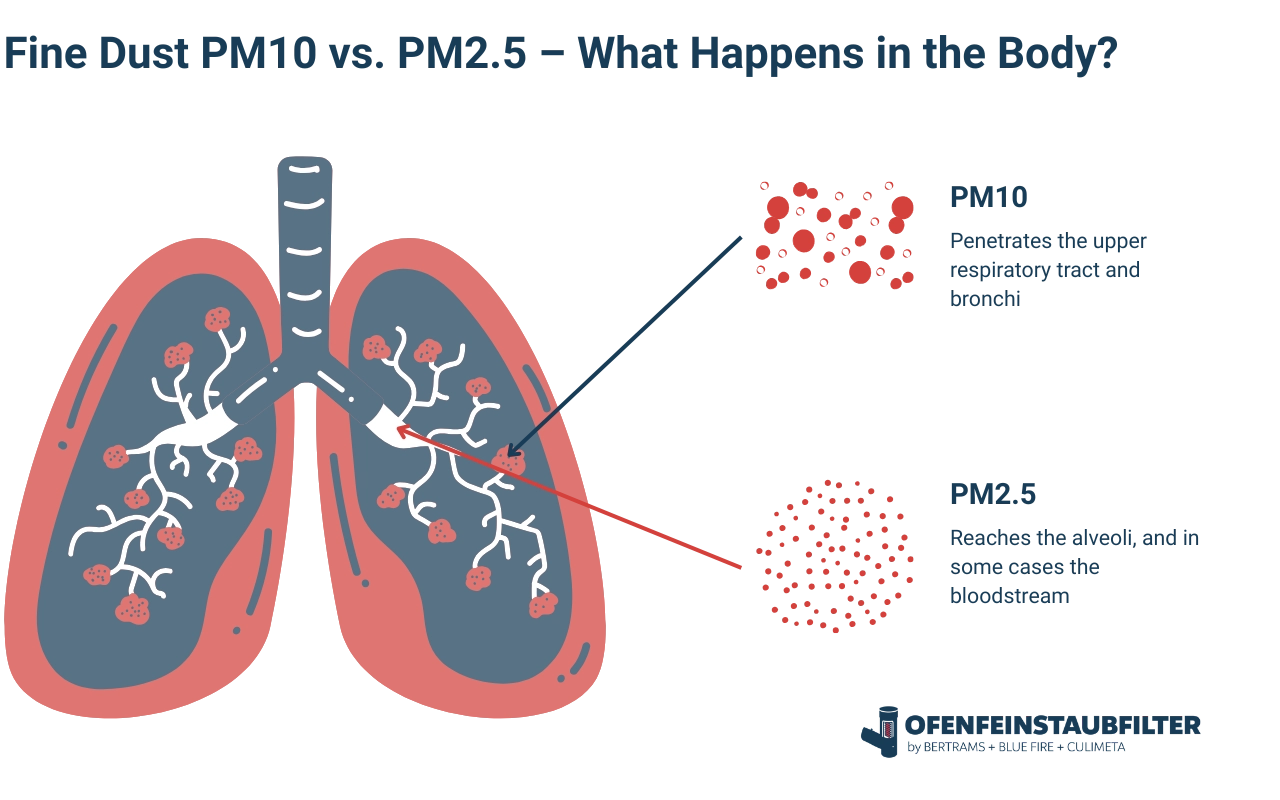
The health effects of particulate matter depend heavily on particle size. Larger particles in the PM10 fraction can penetrate the upper respiratory tract and bronchi, while particularly fine particles (PM2.5) can even reach the alveoli and, in some cases, enter the bloodstream. Fine dust therefore does not remain on the surface of the mucous membranes, but can trigger inflammatory processes in the body.
According to the Federal Environment Agency and the World Health Organisation (WHO), PM2.5 in particular is associated with an increased risk of respiratory and cardiovascular diseases.
Possible consequences include:
- irritated mucous membranes, coughing and breathing difficulties
- worsening of existing conditions such as asthma or COPD
- increased risk of cardiovascular disease in the long term
The following groups are particularly sensitive:
- children whose respiratory systems are not yet fully developed
- elderly people
- people with heart or lung disease
For these groups, additional fine dust from wood-burning stoves and wood-burning ovens represents an avoidable additional burden – especially during the heating season, when many wood-burning stoves are in use at the same time.
The Role of Wood-Burning Stoves in Fine Dust Pollution
Wood-burning stoves contribute significantly to fine dust pollution, especially during the heating season. Particles are produced whenever wood is burned – particularly large amounts if the stove is outdated, damp or unsuitable firewood is used, or the combustion air supply is poorly adjusted. This significantly increases the emission of fine dust from wood-burning stoves and wood-burning ovens, even if the fire looks ‘clean’.
This makes wood-burning stoves and wood-burning ovens one of the relevant sources of fine dust emissions in the winter months – a key reason why fine dust emissions are coming under greater scrutiny and technical solutions such as fine dust filters for wood-burning stoves are gaining in importance.
Impact on the Environment and Air Quality
Particulate Matter From Wood-Burning Stoves and Fireplaces in Residential Areas
Particulate matter from wood-burning stoves and fireplaces is produced directly where people live – in residential streets, housing estates and city centres. When many wood-burning stoves are in use at the same time, the concentration of particulate matter at ground level can increase significantly, especially on cold, windless winter days.
Particulate matter from wood-burning stoves and fireplaces thus contributes noticeably to the background pollution of outdoor air, even if each individual stove appears to have a small impact on its own.
Typical pollution situations are:
- Densely built-up residential areas with many individual stoves
- Heating season with frequent or continuous stove use
- Weather conditions with little wind and inversion weather
Fine Dust Alerts and Your Contribution to Environmental Protection
Put simply, a fine dust alert is issued when fine dust levels in a region are so high that they attract the attention of the authorities or the public. In winter, it is not only traffic and industry that play a role, but also numerous private wood-burning stoves.
You can actively counteract this with clean wood burning:
- Only use dry, untreated firewood
- Set the stove correctly and do not operate it on a low flame with insufficient combustion air
- Ensure regular maintenance and cleaning
- Consider a stove fine dust filter for your wood-burning stove as an additional measure
This will not only improve the air quality in your own living environment, but also make a direct contribution to environmental protection – specifically through your own wood-burning stove.
Current Data and General Conditions Relating to Particulate Matter From Wood-Burning Stoves
Particulate Matter From Wood-Burning Stoves – More Than Just a Marginal Issue
Measurements taken by environmental authorities show that domestic wood burning in winter contributes significantly to particulate matter pollution. During the heating season in particular, wood-burning stoves and other wood-burning appliances contribute significantly to the overall concentration of fine dust in the outdoor air – both in cities and in rural areas.
This makes it clear that fine dust from wood-burning stoves and wood-burning appliances is not purely a local or individual problem, but a relevant factor for air quality that is explicitly taken into account in statistics and clean air plans.
Stricter Requirements for Older Wood-Burning Stoves
At the same time, the legal requirements for small combustion plants have been gradually tightened in recent years. Many older wood-burning stoves are now subject to stricter dust emission limits than when they were installed.
Depending on their year of manufacture, such appliances must either
- comply with certain emission limits,
- or they must be retrofitted, replaced or decommissioned.
This creates double pressure, especially for older stoves without modern exhaust gas cleaning systems: emissions should be reduced for health and environmental reasons – and the legal framework is also becoming more restrictive. However, the specific requirements for retrofitting are not regulated uniformly throughout Germany, but can vary from state to state.
This is exactly where fine dust filters for wood-burning stoves come in: they help to significantly reduce fine dust emissions and better comply with existing regulations.
How Fine Dust Filters Work and Their Advantages
Stove fine dust filters for wood-burning stoves are installed in the flue gas path and filter out most of the particles from the flue gas before it enters the ambient air via the chimney. Depending on the system (e.g. electrostatic separators or other filter solutions), fine dust particles are separated from the exhaust gas stream and retained in the filter area.
With a suitable fine dust filter, the fine dust emissions from a wood-burning stove can be significantly reduced – in many cases, a large proportion of the particles present in the exhaust gas are reduced. This reduces the burden on the outside air, improves air quality for residents and helps to comply with limit values.
A fine dust filter is particularly useful if an older but basically functional wood-burning stove or fireplace is to continue to be used, if the stove is operated in a densely built-up residential area or if it regularly serves as an important source of heat during the heating season. Even in regions where fine dust limits or fine dust alerts are a recurring issue, retrofitting a fine dust filter can be an effective way to significantly reduce emissions – and thus significantly mitigate the health and environmental consequences of fine dust from wood-burning stoves.
FAQs on Particulate Matter From Wood-Burning Stoves and Wood-Burning Ovens
How Can I Find Out Whether My Wood-Burning Stove Is One of the ‘Problem Cases’?
One initial indication is its age: many stoves installed before 2010 often no longer comply with today’s particulate matter limits. You can find information on the type plate (year of manufacture, type) or in the stove documentation. Your chimney sweep can also tell you whether your appliance is affected by stricter regulations and whether retrofitting, replacement or decommissioning is recommended.
Is It Better for the Environment and Health to Avoid Wood Heating Altogether?
Compared to other heating systems, wood burning causes significantly more fine dust. If you have another, cleaner source of heat available, you can limit the use of your wood-burning stove to specific occasions. However, if the stove plays an important role in your heating concept, you can significantly reduce the pollution by operating it consciously (dry wood, correct air supply) and using a fine dust filter – without having to give it up completely.
Is a Fine Dust Filter More Worthwhile Than a New Stove?
That depends on your stove and your situation. If the appliance is in good technical condition but no longer complies with the applicable emission limits, a fine dust filter can be a sensible interim solution: you can continue to use your existing stove while significantly reducing fine dust emissions. If replacement is due anyway (e.g. due to age, efficiency or design), a modern stove with good combustion technology and an optional filter solution may be the better choice in the long term. In many cases, it is worth having a quick chat with your chimney sweep to compare both options.