Why the Chimney Sweep Must Visit Regularly
Regular visits from the chimney sweep are a matter of course for many homeowners – yet at the same time, there is often uncertainty about why these appointments are necessary and what they are based on. The background to this is legally prescribed chimney sweeping work such as cleaning, inspections, and measurements, which serve to protect people, buildings, and the environment and are specified as mandatory in the fireplace certificate.
Safety for Households and the Environment
A key reason for the chimney sweep’s regular activities is the preventive protection against hazards that can arise from combustion systems. This is not only about obvious risks, but also about insidious dangers that often go unnoticed in everyday life.
- Preventive protection in everyday life
Regular inspections help to identify risks at an early stage before they develop into acute safety problems. - Prevention of fire hazards
Deposits such as soot or glistening soot in the chimney can ignite and lead to chimney fires. Sweeping removes residues before they reach a critical level. - Protection against carbon monoxide poisoning
Clogged or damaged exhaust gas paths can prevent toxic exhaust gases from being properly discharged. Carbon monoxide is odorless and particularly dangerous, which is why checking the exhaust gas system is an important protective measure. - Ensuring efficient system operation
Clean exhaust gas paths help heating systems to operate more efficiently. This lowers energy consumption and reduces harmful emissions. - Contributing to environmental protection
Exhaust gas measurements are used to check whether legal emission limits are being complied with. In this way, chimney sweeps contribute to air pollution control and climate protection.
Stove dust filters can help reduce emissions, especially in wood-burning stoves – provided they are installed and maintained/serviced properly.
Legal Basis for Sweeping, Inspection, and Measurement Obligations
Regular appointments are not a voluntary measure, but are clearly regulated by law. In Germany, it is stipulated that certain work must be carried out exclusively or mandatorily in order to ensure the safe operation of fireplaces. These regulations apply nationwide and are binding for owners of buildings with corresponding installations.
Public Safety as a Legal Mandate
The chimney sweep obligation serves not only to protect individual households, but also to serve the greater public interest. It is intended to reduce risks for residents and the neighborhood by regularly checking fireplaces for safe operation and compliance with legal environmental standards. At the same time, the prescribed intervals create legal certainty for owners – for example, in matters of liability or insurance. All work is also officially documented and can be used as evidence for the authorities.
How Often Does the Chimney Sweep Really Come?
There is no general answer to the question “How often does the chimney sweep come?” The actual intervals depend on several factors, in particular the type of heating system, the fuel used, and the frequency of use. Legal requirements provide a binding framework within which the dates fall.
Differences Depending on the Type of Heating System
The type of heating system plays a central role in determining the intervals for sweeping, inspection, and measurement. While modern systems often need to be inspected less frequently, traditional fireplaces require more frequent checks.
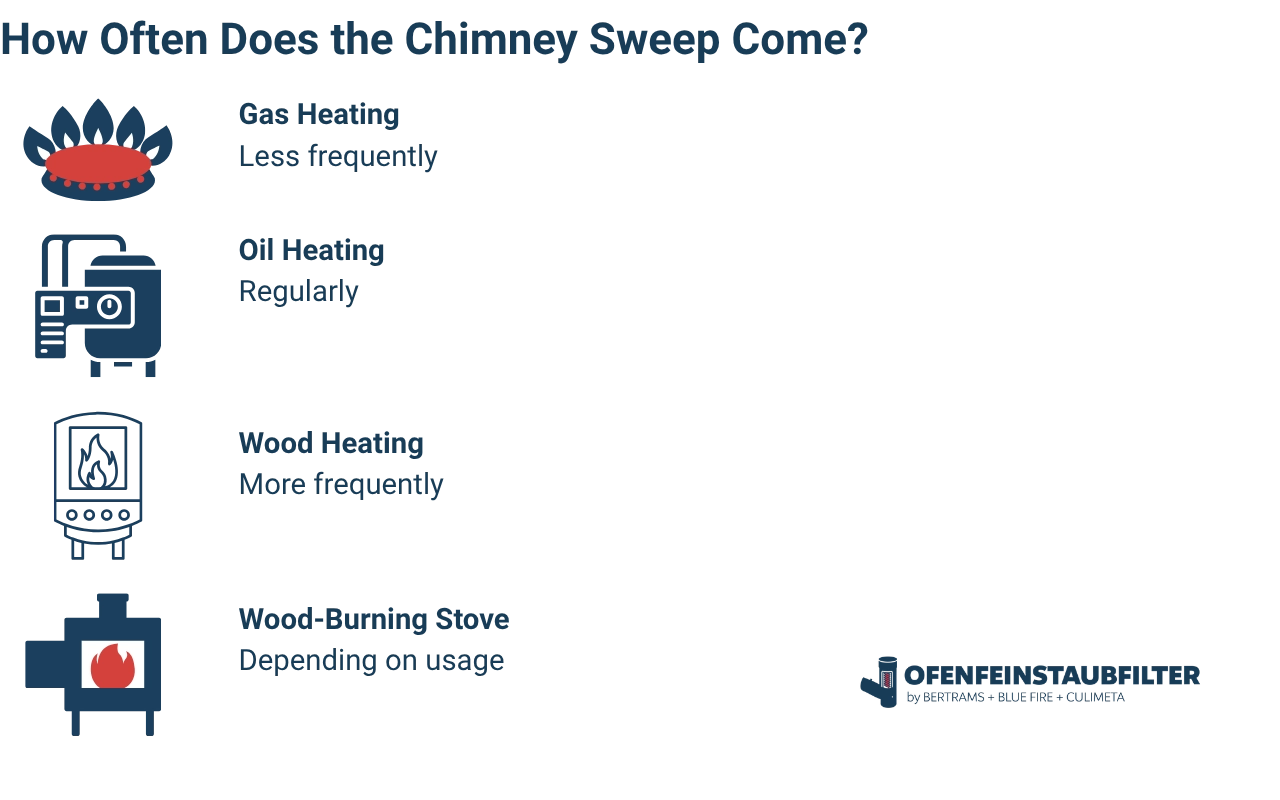
- Gas Heating
Gas-powered systems produce comparatively little soot. In many cases, therefore, inspection at longer intervals is sufficient, although regular exhaust gas measurements are still mandatory. - Oil Heating
Oil heating systems produce more residues than gas heating systems. Therefore, more frequent sweeping and inspections are necessary to prevent deposits and exhaust gas problems. - Solid Fuel Systems (e.g., Wood or Pellets)
Wood-burning stoves, tiled stoves, or pellet heating systems must be inspected particularly often. The combustion of solid fuels produces more ash and soot, which entails a higher risk of fire and emissions. - Open Fireplaces and Single Stoves
Even rarely used fireplaces are subject to fixed intervals. Even if a fireplace is only used occasionally, regular sweeping is required by law.
Solid fuels pose a higher risk of emissions and deposits. For many wood-burning stoves, retrofit solutions such as a fine dust filter or a catalytic converter can therefore be considered, depending on the stove model and installation situation.
Role of Fuel and Frequency of Use
In addition to the type of heating system, the fuel used also influences how often sweeping, inspection, and measurement work is required. Wood, coal, or other solid fuels cause more contamination of the exhaust gas paths than gaseous fuels. At the same time, actual usage also plays a role: a heavily used fireplace usually needs to be inspected more frequently than a system that is only used sporadically.
It is important to note that even low usage does not automatically lead to longer intervals. The legal requirements and the fireplace certificate are decisive – not just the owner’s personal heating habits.
Sweeping, Inspection, and Measurement at a Glance
The work of a chimney sweep can be divided into different types of services, each of which follows its own intervals. This distinction often causes confusion, but it is crucial for understanding the frequency of visits.
- Sweeping
Sweeping involves removing soot, ash, and other deposits from the chimney and exhaust ducts. It serves primarily to prevent fires and is carried out once or several times a year, depending on the system. - Inspection
During an inspection, the chimney sweep checks that the fireplace and exhaust gas system are in proper working order. The aim is to identify technical defects at an early stage and minimize safety risks. - Measurement
Exhaust gas measurement checks whether the system complies with the prescribed emission limits. These measurements are particularly relevant for environmental and health protection and are carried out at specified intervals.
Together, these three services determine how often the chimney sweep actually comes. In many households, this results in several appointments per year, even if individual tasks are only required at longer intervals.

Legal Obligations for Owners
Owners of buildings with fireplaces have a clear legal responsibility. The obligations relating to chimney sweeps are regulated by law and leave little room for individual interpretation. The aim is to ensure the safe and proper operation of all combustion systems on a permanent basis.
Which Dates Are Mandatory
Certain chimney sweep services are required by law and must be performed on time. These include, in particular, sweeping, inspections, and exhaust gas measurements, for which the intervals are binding. The basis for this is the so-called fireplace notice, which informs the owner exactly what work must be carried out and by when.
This notice is legally binding. Failure to comply with the deadlines specified therein may result in official measures being taken.
Fireplace Inspection and Its Intervals
The fireplace inspection plays a special role. This is a comprehensive inspection of all fireplaces, exhaust pipes, and chimneys in a building, as well as the fuel supply and storage. This inspection is not for regular maintenance, but for a fundamental safety assessment.
The fireplace inspection is usually carried out twice within seven years. It may only be carried out by the responsible authorized district chimney sweep. The results form the basis for the fireplace notice and thus for all further mandatory appointments.
Responsibility of Owners for Rented Properties
Even in the case of rented properties, the responsibility for complying with chimney sweep obligations lies with the owner. Even if tenants use the heating system, the legal obligation remains.
The main areas of responsibility include:
-
- Ensuring Access to the Fireplace
Owners must ensure that the chimney sweep can enter the necessary rooms, even if they are rented out.
- Ensuring Access to the Fireplace
Informing and Coordinating with TenantsAppointments must be announced and coordinated in good time so that the work can be carried out properly.Liability for OmissionsIf work required by law is not carried out, owners can be held liable – regardless of whether the cause was the tenant’s fault.
Documentation and Verification Requirements
In addition to carrying out the work, documentation also plays an important role. Owners are required to keep records of completed sweeping, inspections, and measurements. These serve as evidence for authorities and can be crucial in the event of damage.
In particular, during inspections or insurance matters, you may be required to prove that all legal requirements have been met. Complete documentation provides legal certainty and protects against unpleasant consequences.
In addition to sweeping and measurement reports, it is also worth keeping installation reports, product documentation, and instructions for Cleaning and Maintenance—especially for retrofitted components.
Costs and Billing for Chimney Sweep Services
The cost of a chimney sweep is a sensitive issue for many homeowners. At the same time, there is often uncertainty about how these costs are calculated and why they are not freely negotiable. In fact, chimney sweep services are subject to clear legal regulations that are intended to ensure transparency and comparability.
What the Costs Consist of
The amount of the chimney sweep costs depends on several factors. The decisive factor is not only how often the chimney sweep comes, but also what specific services need to be performed. The basis for the calculation is a nationwide uniform fee schedule.
The most important influencing factors include:
- Type and Number of Fireplaces
The more fireplaces there are in a building, the higher the cost. The type of system also affects the cost. - Services Performed
Sweeping, inspections, exhaust gas measurements, and fireplace inspections are billed separately. Depending on the combination, the total cost will vary. - Accessibility of the System
Chimneys that are difficult to access or special structural conditions can increase the amount of work required and have a corresponding effect on the bill. - Regional Conditions
Although the fee schedule is uniform, there may be slight differences, for example due to travel costs or additional inspections.
Typical Price Ranges for Individual Services
Even though the exact costs vary in individual cases, rough guidelines can be given to help owners get an idea of the costs involved. These are for classification purposes only and do not replace individual billing.
In practice, the costs are often in the following ranges:
- Sweeping and Simple Inspections
These are among the less expensive services and, depending on the system, usually cost in the low double-digit range. - Exhaust Gas Measurements
Emissions control measurements are somewhat more complex and often cost in the mid double-digit range. - Fireplace Inspection
Due to its scope, the fireplace inspection is more cost-intensive. However, it is only carried out at longer intervals, so the costs are spread over several years.
It is important for owners to note that in many cases, chimney sweep costs can be passed on to tenants as operating costs, provided this is stipulated in the rental agreement. For owner-occupied properties, they are a fixed component of ongoing maintenance costs.
FAQ
Does the Chimney Sweep Still Have to Come If the Heating System Is Hardly Ever Used?
Yes, even if the heating system is rarely used, it must still be inspected by a chimney sweep. It is not only the actual use that is decisive, but also the fact that a fireplace is available and ready for use. Even with little use, deposits can form or technical defects can go unnoticed. The intervals prescribed by law therefore apply regardless of the individual heating behavior of the owners.
Can I Choose My Own Chimney Sweep Or Am I Tied To A Specific District?
For certain official tasks, such as inspecting fireplaces and issuing fireplace certificates, only the authorized district chimney sweep is responsible. For other work, such as sweeping or exhaust gas measurements, you can also hire another licensed chimney sweep company. It is important to ensure that the work is carried out on time and properly documented, as the responsibility remains with the owner.
Do the Intervals Change if I Modernize My Heating System?
Yes, modernizing your heating system can affect the intervals between chimney sweeps. Modern, low-emission systems are often subject to different testing and measurement requirements than older systems. After installation or conversion, a reassessment is usually necessary, which is carried out as part of a fireplace inspection or individual acceptance test. On this basis, the future intervals are redefined and documented in the fireplace certificate.